There are no items in your cart
Add More
Add More
| Item Details | Price | ||
|---|---|---|---|

"The moment you understand research roles, psychology stops being confusing and starts making sense.”
Dr. Sukanya Pal
Understanding research roles transforms psychology from a subject of memorisation into a discipline of thinking. When students learn how research is produced, who is evaluating it, and what their own role is in using it, psychology stops feeling confusing or random. Instead of guessing what examiners want, students begin to approach evidence with clarity and purpose—knowing when they are expected to reflect as researchers, when they must rely on expert evaluation, and when they are required to balance perspectives using their own critical judgment. This shift empowers students to engage with studies confidently, apply evidence accurately, and write responses that are reasoned rather than rehearsed. In short, understanding research roles does not make psychology harder; it makes thinking visible—and success achievable.
Reflexivity is an internally driven process in which researchers critically reflect on how their own methodological choices shape data and findings, whereas evaluation is an externally driven judgment made by others to assess the validity, reliability, and credibility of the research.
The Psychology IA as a live example of quantitative methodological and ethical reflexivity.
This is exactly what IB Psychology students do in their IA, where they act as junior quantitative researchers. Students do not have the professional access, resources, or ethical clearance to fully reproduce a classic study, so they partially replicate a known experiment—the word “partial” is crucial. Because the context, sample, materials, and setting are different from the original research, students are required to reflect on how these necessary modifications may have influenced their findings. In doing so, they learn the skill of quantitative methodological reflexivity: they explicitly acknowledge limitations introduced by partial replication, evaluate their procedural decisions, discuss sampling constraints, assess the effectiveness of their operationalisations, and consider the adequacy of controls. This reflective critique does not undermine the experiment; instead, it demonstrates mature scientific thinking by showing awareness of how research design choices shape results—precisely what IB examiners reward in the Evaluation section.
Ethical reflexivity in the IB Psychology IA
In the IB Psychology IA, students again act as junior quantitative researchers, and ethical reflexivity is explicitly expected. Although the experiment is quantitative, students are required to reflect on ethical aspects such as:
“Although informed consent was obtained, participants may still have felt pressured to take part…”they are demonstrating ethical reflexivity, not external ethical evaluation.
IB Psychology IA vs ERQ component
When students act as researchers, as in the IB Psychology IA, evaluation of their own study functions as reflexivity, with its form shaped by whether the research approach is quantitative, qualitative, or mixed. When working with secondary research say in ERQ, students do not conduct an authoritative evaluation of the research study/s dealt with themselves, as they lack the professional exposure and disciplinary authority of expert researchers. Instead, they note down the reflexivity of the researchers who conducted the study and rely on and synthesise existing evaluations provided by the scientific community, such as peer-reviewed critiques, replications, and methodological discussions, to comment on the credibility and limitations of the research.
When students act as researchers in the IB Psychology Extended Essay, they do not evaluate a self-generated experimental study as in the IA; instead, their evaluation functions as independent critical thinking grounded in secondary research, shaped by whether the studies they engage with adopt quantitative, qualitative, or mixed-methods approaches. The Extended Essay represents an individual research journey, most commonly operating through an abductive line of reasoning, where students move iteratively between theory and evidence to refine understanding rather than test a single hypothesis. Philosophically, the EE aligns most coherently with critical realism because students treat psychological behaviour as something that exists in the real world, while also recognising that what we know about it depends on how studies are designed, the cultural context in which they are conducted, and how results are interpreted. For your better understanding, Critical realism means believing that behaviour is real, but knowing that research methods and context affect how accurately we understand it. Because EE students rely on secondary data, they do not exercise methodological reflexivity over a study they did not conduct themselves but have chosen as evidence; instead, they identify and articulate the reflexivity demonstrated by the original researchers and critically synthesise how those studies have been evaluated by the scientific community through peer review, replication, and methodological debate just like evaluating research evidence ERQ, while simultaneously applying their own critical thinking to compare findings across theoretical, methodological, and cultural contexts. For example, while authoritative parenting has been associated with improved academic outcomes in Western cultures, studies such as Garcia et al. (2009) and Rahimpour et al. (2015) challenge its cross-cultural universality, suggesting that parenting styles must be culturally adaptive to support adolescent wellbeing—contrasting earlier conclusions drawn by studies such as Dornbusch et al. (1987) and Rivers et al. This form of critical thinking does not claim professional evaluative authority; instead, it represents the student’s own reasoned judgment developed through the careful synthesis of peer-reviewed evidence. In the Discussion section, students actively balance multiple perspectives by comparing converging and diverging findings, weighing methodological strengths and limitations across studies, and examining how cultural and contextual factors shape psychological outcomes. Here, the student moves beyond reporting what researchers have found to interpreting what those findings mean in relation to the research question, resolving tensions between studies, and justifying which explanations are more persuasive. This is why such analysis belongs in the Discussion: it is the space where integration, comparison, and judgment are required, and where the student’s independent critical thinking—grounded in evidence rather than authority—is legitimately exercised.
What's Critical thinking
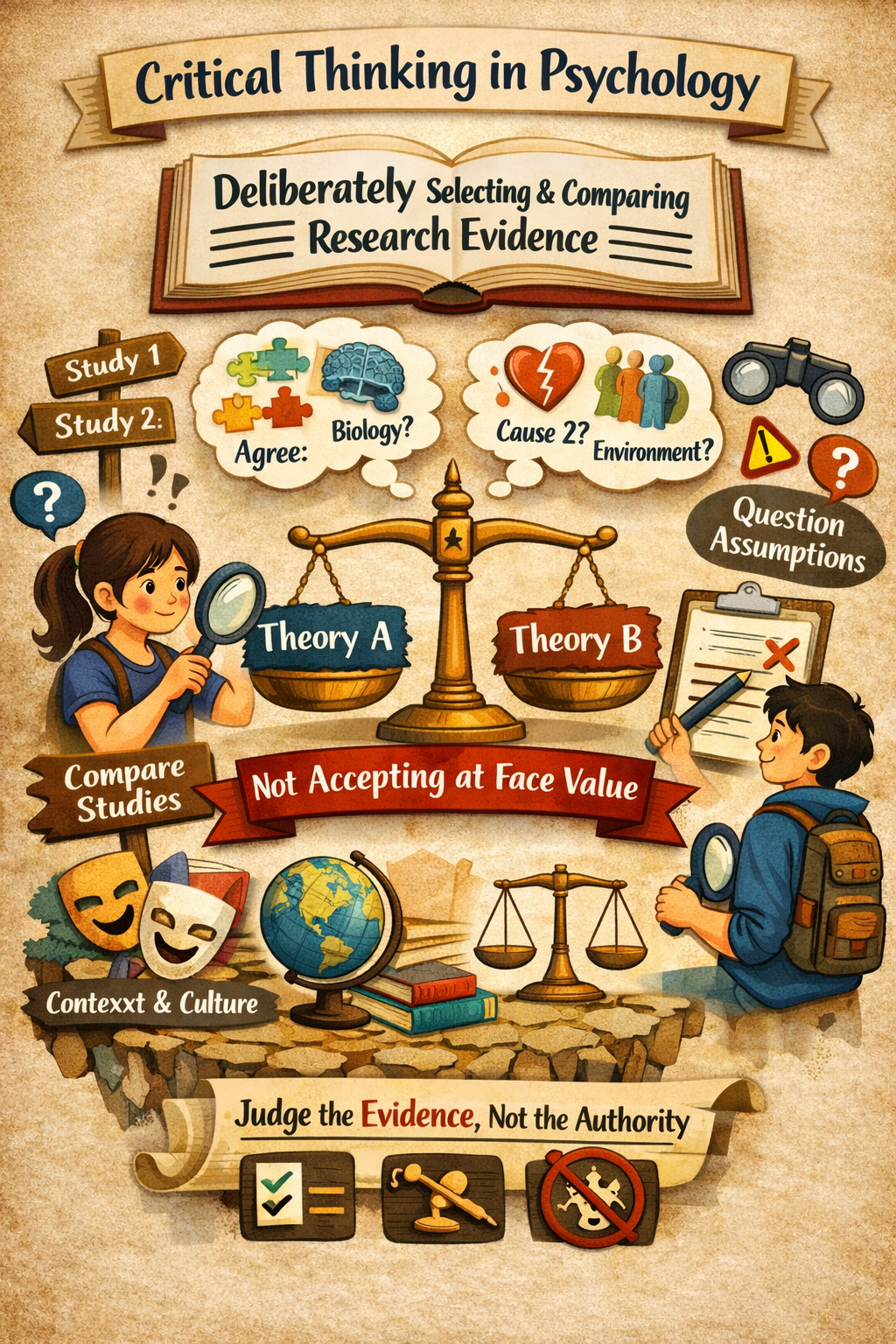
Critical thinking means deliberately selecting and comparing research evidence to weigh alternative explanations, rather than accepting a single study or authority at face value.
In critical thinking, students interpret the consequences and implications of behaviour by synthesising researcher reflexivity and peer evaluation, rather than reflecting on the research themselves or evaluating it with professional authority.
Critical thinking as a very important component of an essay (EE, ERQ)
In psychology, critical thinking is demonstrated when students do not accept a single explanation at face value, but instead compare and weigh alternative interpretations of behaviour using evidence. For example, when examining adolescent academic achievement, a student may encounter research suggesting that authoritative parenting leads to higher academic performance. Rather than accepting this conclusion as universally valid, the student applies critical thinking by making deliberate choices about which research studies to include in an ERQ or Extended Essay, selecting evidence that allows for comparison rather than confirmation. While Western-based research such as Dornbusch et al. (1987) reports positive academic outcomes associated with authoritative parenting, cross-cultural studies like Garcia et al. (2009) and Rahimpour et al. (2015) challenge this interpretation by showing that other parenting styles may be equally or more effective in non-Western cultures. By weighing these competing explanations, evaluating the cultural contexts in which the studies were conducted, and judging the strength of the evidence, the student arrives at a reasoned conclusion: parenting styles cannot be evaluated independently of cultural norms. This process illustrates critical thinking because it shapes both the selection of research evidence and the interpretation of findings, requiring students to balance perspectives, use evidence rather than authority, and construct a justified judgment instead of reproducing a single dominant claim.
You critically think to establish yourself as a responsible knower
A student practises critical thinking to show that, as a knower, they are actively eliminating bias in how they understand and use knowledge, rather than accepting ideas uncritically. In psychology, this is especially important because human behaviour is complex and easily influenced by assumptions, culture, and authority. By thinking critically, the student demonstrates that they are aware of these influences and are deliberately trying to reduce them. First, critical thinking helps eliminate confirmation bias. Students naturally tend to favour studies or explanations that support what they already believe. When a student compares multiple studies, considers counter-evidence, and acknowledges limitations, they show that they are not selectively choosing evidence to “prove” a preferred answer. Instead, they are open to revising their view based on evidence. Second, it reduces authority bias. Psychology students often assume that well-known researchers or classic studies must be correct. Critical thinking shows that the student is not accepting claims simply because they come from experts, but is judging conclusions based on evidence, methodology, and context. This is why students balance studies rather than rely on a single famous one. Third, critical thinking helps minimise cultural bias. Many psychological theories are developed in Western contexts, yet are sometimes treated as universal. When students question whether findings apply across cultures and contexts, they demonstrate awareness that their own cultural lens as a knower can distort understanding. Fourth, it counters oversimplification and absolutist thinking. Human behaviour rarely has one cause or one explanation. By recognising limits, conditions, and alternative explanations, students show they are avoiding the bias of thinking in “always” or “never” terms. In essence, a student uses critical thinking to show that they are a responsible knower—someone who does not let personal beliefs, authority, culture, or convenience decide what counts as knowledge. Instead, they consciously work to judge evidence fairly, acknowledge uncertainty, and reach conclusions that are reasoned rather than biased.
Reflexivity is an internally driven process in which researchers critically reflect on how their own methodological choices shape data and findings, whereas evaluation is an externally driven judgment made by others to assess the validity, reliability, and credibility of the research.
Methodological and ethical reflexivity in quantitative research
Methodological reflexivity does exist in quantitative research, but it operates at the level of design and method, not at the level of the researcher’s identity or personal worldview. In quantitative studies, researchers are reflexive when they critically evaluate how their methodological choices—such as experimental design, procedural structure, sampling methods, operationalisation of variables, and control of confounding variables—may have shaped the results obtained. This form of reflexivity involves recognising that data are not produced in a vacuum: outcomes are influenced by how variables are defined, how procedures are implemented, who participates, and what constraints exist. Rather than interpreting meanings or narratives (as in qualitative reflexivity), quantitative methodological reflexivity strengthens scientific reasoning by improving validity, reliability, and transparency in causal inference.
Ethical reflexivity refers to the researcher’s ongoing and deliberate reflection on the ethical implications of a study at every stage of the research process—before data collection begins, while the study is being conducted, and after it is completed. This form of reflexivity is not restricted to qualitative research; it is equally relevant in quantitative studies, where ethical considerations are closely tied to procedural and design decisions. In quantitative research, ethical reflexivity involves critically examining whether informed consent was genuinely informed, whether participants were adequately protected from psychological or physical harm, and whether any use of deception was justified and followed by appropriate debriefing. It also requires reflection on how confidentiality and data handling were managed, how power imbalances between the researcher and participants may have influenced participation, and whether the potential benefits of the research reasonably outweighed any risks involved. Crucially, ethical reflexivity is embedded within methodological choices rather than treated as a separate checklist, demonstrating the researcher’s awareness that ethical integrity directly shapes both participant wellbeing and the overall quality of the research.
Reflexivity in Qualitative research method
In quaL research, reflexivity is commonly discussed in 4 main types (sometimes a 5th is added), especially in qualitative and mixed-methods research:
Personal reflexivity
Reflects on how the researcher’s own beliefs, values, experiences, and emotions influence the research process and interpretations.
Epistemic (theoretical) reflexivityExamines how the researcher’s assumptions about knowledge and theory shape what is studied, how questions are framed, and how findings are interpreted. Epistemic reflexivity can strengthen interpretation by promoting theoretical awareness and openness to alternative explanations, but when overemphasised it may undermine clarity and lead to excessive relativism or interpretive uncertainty. Relativism turns “there are multiple possible interpretations” into “no interpretation can be judged as stronger than another,” weakening the explanatory power of the research. When epistemic reflexivity becomes overemphasised, the researcher may: hesitate to privilege one explanation over another, avoid drawing firm conclusions, treat findings as endlessly open to reinterpretation, which leads to interpretive uncertainty—the reader is left unsure what the study actually shows.
Methodological reflexivityEthical reflexivity
Ongoing reflection on ethical responsibility, power, consent, representation, and potential harm throughout the research process.
Reflexivity, evaluation, and critical thinking are essential because they ensure that psychological knowledge is used responsibly rather than accepted passively. Reflexivity allows researchers and students to recognise how research choices—such as design, methods, context, and ethics—shape the evidence produced, preventing the illusion that findings are neutral or absolute. Evaluation provides a structured way to judge the strength, credibility, and limitations of research using established scientific standards, protecting knowledge from error, bias, and overgeneralisation. Critical thinking connects these processes by enabling students to weigh competing explanations, balance perspectives, and make reasoned judgments based on evidence rather than authority. Together, these skills are necessary because psychology deals with complex human behaviour that cannot be fully captured by a single study or method. Without reflexivity, evaluation, and critical thinking, research becomes memorised information; with them, it becomes meaningful knowledge that can be questioned, applied, and adapted across contexts.
When students use research in psychology, it is important to understand that they are not performing the same task as researchers or peer reviewers. Researchers show reflection (reflexivity) when they comment on how their own design choices—such as sampling, operationalisation, or context—may have influenced their findings. For example, in a study on parenting style and academic achievement, the researchers themselves may acknowledge that their sample was drawn mainly from middle-class Western families, limiting the cultural generalisability of their conclusions. This reflection belongs only to the people who conducted the study, because they are reflecting on decisions they personally made. Evaluation, on the other hand, is carried out by peer reviewers and the wider scientific community, not by students. Peer reviewers may critically assess whether the research design was appropriate for the research question, whether the sample size was sufficient, or whether alternative explanations were adequately controlled. For instance, reviewers may point out that a study linking authoritative parenting to academic success relies heavily on self-report measures, raising concerns about social desirability bias. This evaluation is professional and authoritative, based on disciplinary expertise. When students encounter two studies addressing the same research question—such as “To what extent does parenting style influence adolescent academic achievement?”—their role is neither reflection nor professional evaluation. Instead, students engage in critical thinking through synthesis. They draw on the researchers’ own reflections and the evaluations provided by peer reviewers to compare findings across studies. For example, a student may note that while one Western study reports positive academic outcomes associated with authoritative parenting, another cross-cultural study challenges this conclusion by showing different patterns in non-Western contexts. Using existing evaluations, the student judges which explanations are more convincing and explains why cultural context may account for these differences. This final step is where the student’s own critical thinking appears. The student is not claiming expert authority or inventing new critiques. Rather, they are balancing perspectives, deciding how much weight to give to each study, and reaching a reasoned conclusion that directly addresses the research question. This is why student writing is assessed on critical thinking rather than evaluation or reflexivity: the student’s task is to make sense of expert knowledge, not to replace it.
What a student does in critical thinking
A student does not reflect on the research process itself (that is reflexivity, and it belongs to the researcher), and the student does not evaluate the study with professional authority (that is evaluation, and it belongs to peer reviewers).
Instead, when a student engages in critical thinking, they:
- take researcher reflexivity (how researchers explain limits and context)
- take peer evaluation (how experts judge methods and credibility),
- and then interpret the consequences of behaviour and findings in relation to the research question.
In other words, the student asks:
Given what researchers say about their own work, and given how experts have evaluated that work, what does this evidence actually mean for understanding behaviour?
In critical thinking, students interpret the consequences and implications of behaviour by synthesising researcher reflexivity and peer evaluation, rather than reflecting on the research themselves or evaluating it with professional authority.
Big areas to focus on in Critical thinking
When students engage in critical thinking in psychology, they are not trying to sound clever or dismiss research; they are trying to judge knowledge carefully and responsibly. The following are the big areas students should deliberately focus on when doing critical thinking—whether in ERQs, the Extended Essay, or the Discussion section.
1. Methodological quality Students should examine how the research was conducted, not just what it concluded. This includes considering the research design, sample size and characteristics, operationalisation of variables, controls, and data collection methods. Strong critical thinking asks whether the method was appropriate for the research question and how methodological limitations may have influenced the findings.
2. Validity and reliability of findings Critical thinking involves questioning how accurate and consistent the results are. Students should consider internal validity (whether the study truly measured what it claimed), external validity (generalisability), and reliability (whether findings would be consistent if repeated). This helps avoid treating single-study results as definitive truth.
3. Cultural and contextual influences Psychological findings are often shaped by cultural norms, social expectations, and situational contexts. Students should critically assess whether conclusions drawn in one cultural or social setting can be applied elsewhere. This is especially important in topics like parenting, emotion, identity, and behaviour.
4. Alternative explanations Good critical thinking always asks: What else could explain these results? Students should explore competing explanations, confounding variables, or theoretical alternatives rather than accepting the researchers’ preferred interpretation unquestioningly. This shows depth of understanding rather than scepticism for its own sake.
5. Ethical considerations Students should consider how ethical choices—such as informed consent, deception, participant wellbeing, and power relationships—may have influenced behaviour and data quality. Ethical awareness strengthens critical thinking by linking research practice to research integrity.
6. Consistency across studies Rather than relying on a single study, students should compare findings across multiple research studies. Critical thinking involves identifying patterns, contradictions, and trends in the literature and explaining why different studies may reach different conclusions.
7. Strength of evidence and claims Students should assess whether the conclusions match the evidence. This includes identifying overgeneralisation, exaggerated claims, or conclusions that go beyond what the data reasonably support. Strong critical thinkers distinguish between correlation and causation and recognise the limits of inference.
8. Theoretical framework Critical thinking requires understanding how research fits within broader psychological theories. Students should evaluate whether the theory adequately explains the findings, whether alternative theories exist, and how well the evidence supports the theoretical claims.
9. Balance, not bias The goal of critical thinking is not to attack research, but to balance perspectives. Students should acknowledge strengths as well as limitations, showing fairness and intellectual maturity. This balance is essential for high-level responses.
10. Implications and application Finally, students should consider what the findings mean in real life and whether applications are appropriate or overstated. This helps bridge theory and practice while maintaining caution and realism.
Consider the research question: “To what extent does authoritative parenting influence adolescents’ academic achievement?”
Two studies are commonly used as evidence. A Western-based study (for example, Dornbusch et al.) reports that adolescents raised with authoritative parenting styles show higher academic performance. In their own paper, the researchers reflect that their findings may be shaped by the cultural context of the sample, which largely consists of middle-class families from Western societies. This reflection is the researchers’ acknowledgement that their methodological and contextual choices may have influenced the results. Following publication, peer reviewers and later researchers evaluate this study. They point out methodological issues such as reliance on self-report questionnaires, possible social desirability bias, and limited cultural generalisability. These evaluations are not written by students; they are professional judgments made by experts in the field and become part of the secondary literature surrounding the study. A second study (such as Garcia et al. or Rahimpour et al.), conducted in a non-Western cultural context, reports that authoritative parenting does not show the same strong relationship with academic achievement, and that other parenting styles may be equally effective. The researchers again reflect on their own design, noting cultural values around obedience, family hierarchy, and interdependence that may influence how parenting styles operate. Peer reviewers then evaluate this study, discussing strengths such as cultural relevance and weaknesses such as differences in how “academic success” is operationalised. Now the student’s critical thinking begins. The student does not critique the sampling method as if they were a peer reviewer, nor do they reflect on research decisions they did not make. Instead, the student synthesises what already exists. They compare the findings of both studies, use the researchers’ reflections and peer evaluations as evidence, and decide how much weight each study should carry in answering the research question. The student may argue that authoritative parenting appears effective in Western contexts but is not universally predictive of academic success, because cultural norms shape how parenting behaviours are experienced by adolescents. This judgment is the student’s own, even though it is built entirely on expert work. The student is not repeating one study’s conclusion, nor listing isolated strengths and limitations. Instead, they integrate evidence, resolve contradictions, and reach a reasoned conclusion that directly addresses the research question. This is why such writing is assessed as critical thinking: it demonstrates the ability to make sense of expert knowledge by balancing perspectives, rather than claiming authority or producing original evaluation.
1. An Essay is a mode of thinking, not a format only
An essay is not defined by how long it is, how many paragraphs it contains, or which subject it belongs to. Those are surface features. At its core, an essay is defined by the kind of thinking it demands from the writer. This is why an essay in Psychology, ESS, History, TOK, or the Extended Essay all share the same intellectual foundation despite looking very different on the page. An essay is a reasoned written response to a question. In responding, the writer must take a position—sometimes explicitly, sometimes implicitly—support that position with appropriate evidence, and then evaluate the strength and limits of that evidence in order to reach a justified judgement. The defining feature is not explanation, but judgement. If a piece of writing remains at the level of stating information, describing theories, or summarising studies, it does not qualify as an essay. Even fluent, detailed, and accurate writing fails as an essay if it does not move beyond knowledge into evaluated meaning.
2. The Core Spine of every Essay
Despite differences in subject matter and command terms, all academic essays operate on the same intellectual spine: Claim → Evidence → Evaluation → Judgement The claim answers the question by stating what the writer is arguing or asserting. The evidence provides support for that claim, whether in the form of studies, data, examples, or textual references. Evaluation then examines how strong, reliable, or limited that evidence is. Finally, judgement draws a reasoned conclusion based on the evaluation rather than repeating information. This spine does not change when the subject changes. A Psychology ERQ, an ESS essay, a TOK essay, and an Extended Essay all succeed or fail based on how well this sequence is sustained. Command terms may shape emphasis, and mark allocations may affect depth, but the underlying structure of thinking remains constant.
3. Is an Essay Always an Argument?
Yes—but it is crucial to understand what argument means in academic writing. Argument does not imply aggression, debate, or emotional persuasion. In an academic context, an argument is the act of advancing a reasoned position that can be examined, questioned, and supported with evidence. An essay is always argumentative because the writer must make choices. They select some ideas over others, prioritise certain evidence, and organise material in a way that leads the reader toward a conclusion. Even when the tone is neutral or explanatory, the act of evaluation—judging relevance, strength, and limitation—is inherently argumentative. This is why an essay can appear calm, balanced, and analytical, yet still be an argument. The argument lies not in the language of persuasion, but in the logic of judgement that underpins the writing.
4. The Claim: Theory, Issue, and Thesis
The claim in an essay is not a random opinion or a vague stance; it is the writer’s theoretically grounded position in response to the question. In subjects such as Psychology and ESS, the claim often emerges from a theory or conceptual framework applied to a specific issue, while in TOK the claim is explicitly framed as a thesis—a defensible answer to the prescribed title. In a TOK essay, a hook is important because it situates the knowledge question in a real-life or conceptual context, allowing the thesis to emerge as a necessary response rather than an abstract assertion. A strong hook frames the problem space clearly, so the reader understands why the thesis matters before encountering what the thesis claims. A thesis is the writer’s clear, contestable answer to the prescribed title, expressed as a central claim that will be explored, evaluated, and refined across the essay. It does not merely state a topic; it takes a position that invites examination, guiding the direction and boundaries of the argument that follows. Importantly, the claim also signals the journey of the essay: it indicates how the writer will proceed in addressing the question and why certain evidence or perspectives will be prioritised. In this sense, the thesis in TOK and the claim in other IB subjects perform the same intellectual function. They announce not only what is being argued, but also the direction of reasoning the essay will follow, ensuring that the argument remains coherent, purposeful, and evaluative throughout.
5. Command terms connecting with essay types
“To what extent” — what students must actually do When a question says “to what extent”, the student must take a clear stand and then test how strong that stand really is using evidence. The answer should not sit on the fence. First, the student states how far they agree with the claim in the question. Then, they use research to support that position by showing where the explanation works well. After this, the student must challenge their own position by discussing evidence that limits, weakens, or qualifies the claim. Finally, the student reaches a balanced conclusion that clearly explains how far the claim is valid and under what conditions it holds true. Full marks are given when the student shows they can argue for a position, question it using evidence, and still arrive at a reasoned judgment instead of a one-sided answer. To what extent → Persuasive (balanced persuasion)
A to what extent essay is persuasive because the student takes a position and convinces the reader how far it is valid, while openly acknowledging and addressing its limits.
 Launch your Graphy