There are no items in your cart
Add More
Add More
| Item Details | Price | ||
|---|---|---|---|

A complete roadmap: what you study, why it matters, and how you score
This page gives a solid understanding of how IB Psychology - 2027 works, why it is designed this way, and how students are expected to think
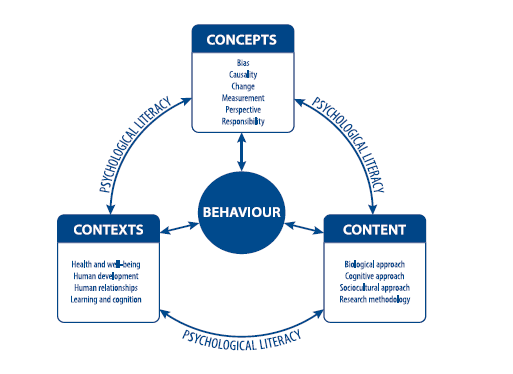
The speciality of the IB Psychology 2027 Curriculum Model: Why a Triad, Not a Syllabus List The IB Psychology 2027 curriculum is distinctive because it is not organised as a list of topics to be covered but as a thinking framework to be developed. At the heart of this framework is a deliberate triad—concepts, content, and contexts—designed to mirror how psychological understanding is constructed in the real world. Psychology, as a discipline, does not progress by accumulating facts; it progresses by using ideas to explain behaviour, evidence to test those ideas, and contexts to determine whether those explanations hold beyond controlled settings. The curriculum model is therefore structured to train students in this way of thinking rather than in surface-level recall. This triadic design ensures that students are not learning Psychology about humans but learning Psychology for understanding humans. Each part of the triad plays a distinct role, and the subject only functions effectively when all three operate together. Removing or isolating any one element weakens understanding and reduces Psychology to memorisation or opinion.
Ref: This embedded outline is an original presentation informed by publicly available International Baccalaureate® Psychology curriculum documentation. The purpose of embed is to stimulate IB students to read IB official documents.
What are Concepts in IB Psychology 2027—and Why they Matter: Concepts are not definitions to be memorised; they are intellectual tools that help students organise and interrogate behaviour. Concepts such as bias, causality, change, measurement, perspective, responsibility, and interaction allow students to ask meaningful questions about psychological explanations. Rather than learning isolated theories, students learn to view behaviour through these conceptual lenses. The importance of concepts lies in their transferability. A student who understands the concept of bias can apply it to memory research, media claims about mental health, eyewitness testimony, or algorithm-driven social media behaviour. Concepts therefore prevent Psychology from becoming fragmented. They act as bridges that connect different areas of the course and enable students to handle unfamiliar questions with confidence. In assessments, especially in IB Psychology - 2027, marks are awarded for conceptual reasoning rather than factual density, making concepts central to success.
What Is Content in IB Psychology 2027—and How it is Used: Content in IB Psychology 2027 includes psychological approaches, theories, models, research studies, and research methodologies. However, content is not treated as an end in itself. Its role is to provide the explanatory substance that concepts operate on. Theories and studies are therefore learned as evidence for explanations, not as standalone knowledge. This is a critical shift in how students must approach learning. A study is not remembered because it is examinable; it is understood because it demonstrates how a psychological idea has been tested. Content provides the language, mechanisms, and empirical grounding that allow students to explain behaviour scientifically. When content is learned in isolation, students struggle to apply it. When content is learned as part of a conceptual explanation, it becomes meaningful and easier to retrieve under exam conditions. What are Contexts in IB Psychology 2027—and Why they are essential: Contexts in IB Psychology 2027 are real-life settings in which behaviour occurs, such as health and well-being, learning and cognition, human development, and social relationships. Contexts ensure that Psychology is not treated as an abstract academic exercise but as a discipline that explains lived human experience. The inclusion of contexts reflects a fundamental truth about behaviour: psychological explanations are always situation-dependent. A theory that explains memory in a laboratory may not fully explain memory under stress. A model that accounts for decision-making in isolation may change when social pressure is introduced. By embedding psychological explanations within contexts, the curriculum trains students to think flexibly and critically, recognising both the power and the limits of psychological knowledge. In assessments, contexts are the space where application occurs. Students are expected to take conceptual understanding and content knowledge and deploy them in situations they may not have encountered before. This is why contexts are not “topics” to revise but arenas in which thinking is tested.
How Concepts, Content, and Contexts work together: The true strength of the IB Psychology 2027 curriculum lies not in the individual elements of the triad but in their integration. Concepts shape how students think, content provides what they think with, and contexts determine where that thinking applies. Together, they create a system that rewards understanding over recall. For example, when analysing exam stress, a student might use the concept of interaction to integrate biological stress responses, cognitive appraisal processes, and sociocultural pressure within an educational context. This kind of answer demonstrates psychological literacy because it shows awareness of complexity, evidence, and application simultaneously. It is this integration that examiners look for across all papers and the internal assessment.
Psychological Literacy: The Outcome of the Curriculum Model The ultimate goal of IB Psychology 2027 is psychological literacy. Psychological literacy refers to the ability to understand, evaluate, and responsibly apply psychological knowledge in everyday life. A psychologically literate student does not merely know psychological terms; they can interpret behavioural claims, question evidence, recognise limitations, and make informed decisions. This literacy is essential in a world saturated with claims about mental health, productivity, motivation, learning styles, and technology. The curriculum model ensures that students are equipped not just to pass examinations but to engage thoughtfully with such claims long after the course ends. By integrating concepts, content, and contexts, IB Psychology 2027 develops students who can think critically about behaviour rather than accept explanations uncritically.
How IB Psychology 2027 is built: The Idea–Evidence–Application Engine IB Psychology - 2027 is built around a precise intellectual structure that governs how students learn, write, and are assessed. At every stage of the course, students are trained to explain behaviour using psychological ideas, justify those explanations using evidence, and apply their understanding to real situations. This is not an accidental design choice; it reflects the way psychological knowledge itself is constructed and evaluated. In IB Psychology - 2027, knowing information is never sufficient on its own. Students may remember multiple studies, theories, or key terms, but unless they can use those elements to explain behaviour in unfamiliar contexts, marks are not awarded. This is why students who treat the subject as a memorisation task often feel disoriented. The curriculum expects students to reason through behaviour, not recall rehearsed responses. For example, when a student claims that they can only revise effectively when stressed, IB Psychology - 2027 does not reward encouragement or opinion. A high-quality response explains how stress hormones affect attention and memory processes, distinguishes between optimal and excessive arousal, and evaluates how strategies such as sleep regulation, spaced learning, and cognitive reappraisal alter learning outcomes. This logic—cause, mechanism, outcome—runs through every paper and the internal assessment. Once students internalise this engine, IB Psychology becomes structured, predictable, and intellectually coherent.
How the IB Psychology - 2027 Curriculum Model works: This Way The IB Psychology 2027 curriculum model is intentionally organised around the integration of concepts, content, and contexts because psychological literacy cannot develop through fragmented learning. Human behaviour is complex, multi-determined, and context-dependent. A curriculum that separates theory from application would fail to reflect how behaviour actually operates in real life. Concepts in IB Psychology - 2027 function as organising lenses that help students frame and interrogate behaviour. Content provides the theoretical frameworks, models, and research methods needed to explain behaviour systematically. Contexts place these explanations within real-world settings such as health, learning, development, and social relationships. When these three elements are integrated, students learn not just what psychologists claim, but why those claims exist, how they are supported, and where they apply. This model ensures that IB Psychology - 2027 develops psychological literacy rather than surface familiarity. Students learn to interpret behavioural claims critically, evaluate evidence responsibly, and recognise the limits of explanations. The curriculum therefore prioritises application, analysis, and evaluation over recall, aligning assessment with meaningful understanding rather than volume of content.
The Approaches in IB Psychology - 2027: One Behaviour, Multiple Explanations IB Psychology 2027 trains students to understand that behaviour cannot be explained from a single perspective. The curriculum requires students to analyse behaviour through biological, cognitive, and sociocultural approaches, each addressing different underlying mechanisms. These approaches do not compete for correctness; instead, they reveal different layers of influence operating simultaneously. The biological approach in IB Psychology - 2027 explains behaviour by examining brain structures, neurotransmitters, hormones, genetics, and physiological systems. Students are expected to explain how biological mechanisms influence behaviour, not simply name them. For instance, when analysing exam anxiety, a strong response traces how stress activates the hypothalamic–pituitary–adrenal axis, increases cortisol levels, narrows attentional focus, and disrupts working memory, leading to impaired retrieval. Evidence from brain imaging or hormone studies is used to support the explanation, and limitations such as reductionism, correlational evidence, and ethical constraints are evaluated. The cognitive approach in IB Psychology - 2027 focuses on internal mental processes, including attention, memory, perception, interpretation, and reasoning. Behaviour is understood as the outcome of how information is processed and meaning is constructed. Students must explain mechanisms such as schema-driven recall, cognitive appraisal, and reconstructive memory in a step-by-step manner. For example, when two students respond differently to identical feedback, a cognitive explanation examines how interpretation shapes emotional response and subsequent behaviour. Evaluation considers ecological validity, artificiality of experimental tasks, and cultural influences on cognition. The sociocultural approach in IB Psychology 2027 examines how behaviour is shaped by social interaction, group norms, cultural expectations, and social learning. Students analyse mechanisms such as conformity, obedience, social identity, modelling, and deindividuation. When explaining why a student behaves kindly in isolation but aggressively in an online group, a strong sociocultural analysis explores group norms, identity signalling, and reduced accountability, supported by research evidence and evaluated through ethical and methodological considerations. Moral judgement is avoided; behaviour is explained through social forces.
Research Methodology in IB Psychology - 2027: How Psychological Knowledge Is Earned Research methodology is not a discrete chapter in IB Psychology 2027; it underpins every explanation and evaluation. Students are required to understand how psychological knowledge is generated, tested, interpreted, and limited. This includes experimental and non-experimental methods, qualitative and quantitative designs, and the logic governing research decisions. Success in IB Psychology 2027 depends on applying research concepts meaningfully. Students often struggle when they memorise definitions of validity, reliability, or bias without explaining their relevance. For instance, when evaluating a memory study that uses random word lists, a high-level response explains that such tasks may prioritise short-term rehearsal rather than meaningful recall, limiting ecological validity, while acknowledging that controlled conditions strengthen internal validity. Ethical evaluation similarly requires explanation of why procedures such as deception are used, how harm is minimised, and how participant rights are protected. Across all assessments, IB Psychology 2027 rewards students who can articulate what a method measured, why it suited the research aim, how it strengthens or weakens conclusions, and what alternative explanations remain plausible. This analytical approach is essential for Paper 2, Paper 3 at higher level, and the internal assessment.
Contexts in IB Psychology - 2027: Where understanding becomes applicable, Contexts in IB Psychology - 2027 function as real-life arenas in which psychological explanations are tested and applied. Students do not study behaviour in abstraction; they examine how psychological mechanisms operate within meaningful settings. In health and well-being contexts, students analyse stress, coping, resilience, health behaviours, and mental health literacy. High-quality responses integrate biological stress responses, cognitive appraisal processes, and sociocultural pressures when explaining outcomes such as burnout, avoidance, or reduced motivation. Practical implications are essential, as the curriculum emphasises understanding behaviour in order to inform change. Human development contexts require students to explain how behaviour changes across the lifespan, focusing on identity formation, attachment, adolescence, and moral development. Explanations must show interaction between biological maturation and environmental influence over time. For example, adolescent risk-taking is analysed through neurological development, peer influence, and social identity formation. Learning and cognition contexts allow students to apply psychological theory directly to academic behaviour. Students explain why strategies such as rereading are ineffective, how retrieval practice strengthens memory consolidation, and why stress impairs recall. This context rewards students who translate psychological understanding into effective learning strategies. Relationships and social behaviour contexts examine conformity, obedience, aggression, cooperation, and social influence. Students analyse how group dynamics shape behaviour, avoiding moral judgement and focusing instead on mechanisms and evidence.
How IB Psychology - 2027 Questions are answered and assessed across all assessment components: IB Psychology - 2027 rewards structured reasoning. High-scoring answers clearly explain psychological ideas, support claims with appropriate evidence, apply understanding to the specific prompt, evaluate limitations and alternatives, and maintain logical organisation. Low-scoring answers often separate theory from research, narrating studies without integration. Successful responses follow a consistent structure: a claim is explained through a psychological mechanism, supported by evidence, evaluated for limitations, and explicitly linked back to the question. This structure applies across Paper 1, Paper 2, and Paper 3 at higher level.
Internal Assessment in IB Psychology - 2027 Designing: Understanding The internal assessment in IB Psychology 2027 requires students to produce a research proposal, not conduct a full study. This task assesses the ability to design coherent, ethical, and feasible research grounded in psychological concepts. High-scoring proposals are characterised by clarity of research question, appropriate variables and measures, justified sampling, transparent procedures, and ethical awareness. Complexity is not rewarded; coherence is.
Every learner’s IB Psychology journey is different.
Share a few details so we can guide you with clarity, care, and academic precision. Stay informed with insights on how IB Psychology builds thinking skills, confidence, and long-term understanding of simple exam strategies, clarity notes, and reflections that help you think better.
IB Psychology - 2027 welcomes students to understand human behaviour deeply and apply that understanding across disciplines. It develops analytical thinking, research literacy, and insight into learning, decision-making, and social interaction. No prior knowledge of Psychology is required; success depends on willingness to think carefully and systematically. If this explanation clarified how IB Psychology 2027 works, you are already engaging with the subject in the way the curriculum expects. The course that follows this framework does not train memory—it trains understanding.
 Launch your Graphy