There are no items in your cart
Add More
Add More
| Item Details | Price | ||
|---|---|---|---|

Stress is usually treated as something to eliminate.
Psychology treats it differently. Stress can be trained. When students encounter stress repeatedly in a predictable, manageable form, the brain adapts. This process is known as stress inoculation. The nervous system learns that stress does not automatically signal danger—it can signal demand. Biologically, this training recalibrates the stress response. Cortisol is still released, but in smaller, shorter bursts. The prefrontal cortex maintains control instead of being hijacked by the limbic system. This is how stress becomes a skill. Students who practise under exam-like pressure—timed writing, decision-making, evaluation—teach their brains how to function while stressed. Over time, stress stops being overwhelming and becomes informative. The brain learns:
Why this fits the stress continuum:
McGonigal explains that stress follows a performance curve—moderate stress enhances focus, memory, and resilience, while unmanaged stress harms health and performance. She powerfully reframes stress as a resource, showing that how we interpret stress determines whether it keeps us in the optimal zone or pushes us into burnout. For students, this talk directly connects biology, mindset, and peak performance before exams.
When understood and harnessed, stress becomes a skill—it sharpens focus, mobilizes energy, and pushes performance under pressure. The problem isn’t stress itself, but the belief that stress is harmful. Reframing stress as a resource allows the brain to work with it, not against it—especially in exams, performances, and high-stakes moments.
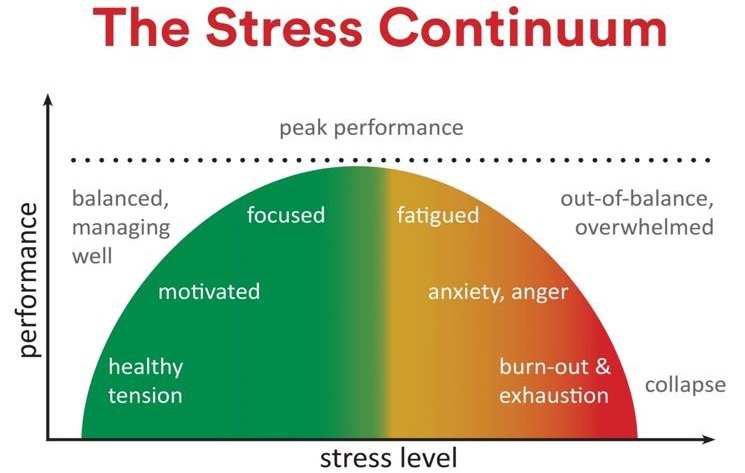
This stress continuum shows that stress is not simply good or bad—it is a range that directly shapes performance. At low to moderate levels, stress creates healthy tension, motivation, and focus, pushing the brain into its peak performance zone where learning, recall, and problem-solving are strongest. As stress increases beyond this optimal point, the same arousal turns counterproductive, leading to fatigue, anxiety, emotional reactivity, and eventually burnout and collapse. The key insight is that success is not about eliminating stress, but about staying in the optimal middle zone, where stress is regulated, purposeful, and used as fuel rather than allowed to overwhelm the system.
The stress continuum reframes stress as a dynamic process rather than a fixed state. It shows that performance rises with stress up to an optimal point, where alertness, motivation, and cognitive sharpness are at their highest. Beyond this point, however, the same physiological arousal begins to overload the brain, narrowing attention, disrupting memory retrieval, and triggering emotional reactivity. What makes the continuum powerful is its message of self-regulation: success depends not on avoiding stress, but on recognizing early warning signals and deliberately bringing oneself back into the optimal zone. Students who understand this learn to treat stress as adjustable—something to be calibrated, not feared.
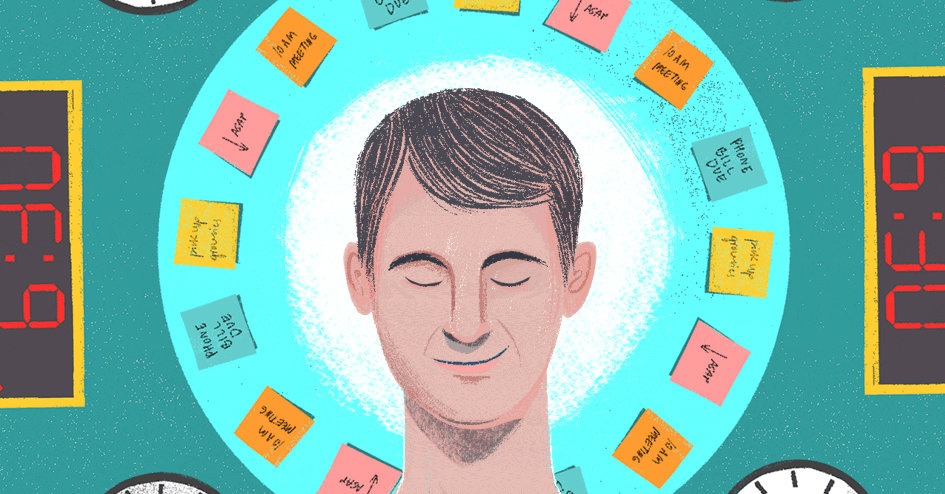
This image represents the regulation point of the stress continuum. While the stress continuum shows what happens to performance as stress increases, this image shows how the brain can be brought back into the optimal zone. The calm face at the center symbolizes a regulated nervous system, and the sticky notes circling the head represent external demands—deadlines, meetings, messages, expectations—that constantly push stress upward. When these demands remain outside the core, the brain stays focused and balanced (the green zone of the continuum). When they intrude into the center, stress shifts toward anxiety, overload, and burnout. It visually explains that peak performance is not about having fewer stressors, but about keeping them at the periphery of attention, so stress remains a skill—not a threat.
Turn it too low, and the mind drifts.
Turn it too high, and the system distorts.
Tune it just right, and performance comes alive.
Every learner’s IB Psychology journey is different.
Share a few details so we can guide you with clarity, care, and academic precision. Stay informed with insights on how IB Psychology builds thinking skills, confidence, and long-term understanding of simple exam strategies, clarity notes, and reflections that help you think better.
 Launch your Graphy
 “Stress is not the enemy; it’s the signal that you care.”