There are no items in your cart
Add More
Add More
| Item Details | Price | ||
|---|---|---|---|

The human brain did not evolve to be slow and exhaustive.
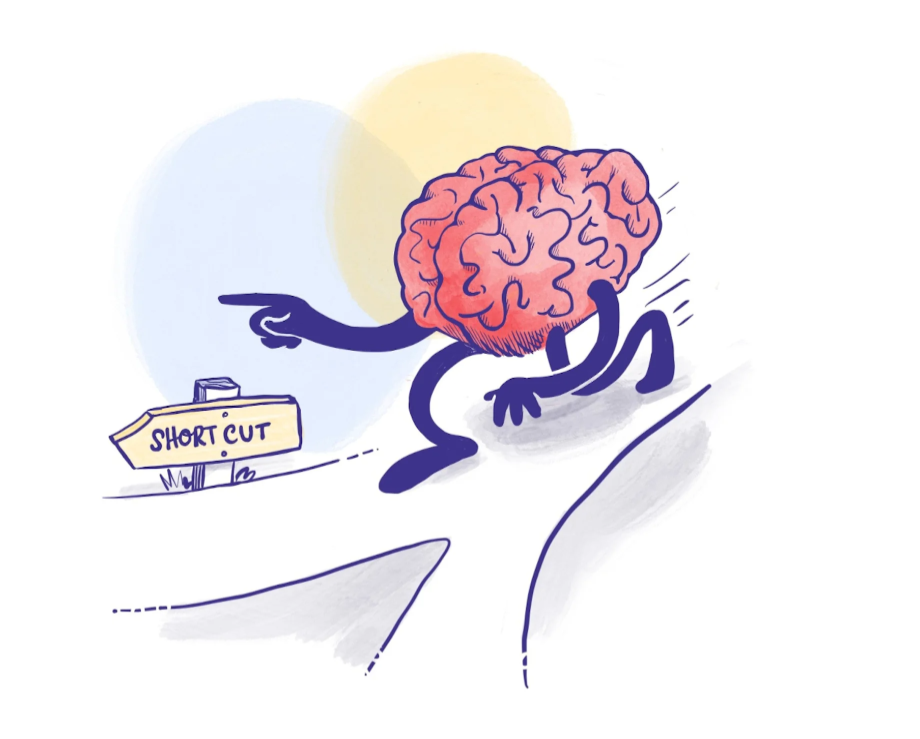
It evolved to be efficient. To manage overwhelming information, the brain relies on cognitive shortcuts, known as heuristics. These shortcuts allow rapid judgments with minimal effort. Most of the time, they work remarkably well. But efficiency comes at a cost. Heuristics trade accuracy for speed. In everyday life, this is adaptive. In exams, however, these shortcuts can quietly sabotage performance. For example, when a familiar study name appears in a question, the brain immediately reaches for it—even if it’s only partially relevant. This is the availability heuristic in action. The brain prefers what is easy to retrieve over what is most appropriate. Exams exploit this tendency. IB questions are deliberately designed to look familiar while requiring selective restraint. They reward students who pause, inhibit automatic responses, and evaluate relevance. This is cognitively demanding because it goes against the brain’s natural preference for shortcuts. Neuroscientifically, resisting shortcuts requires strong prefrontal cortex control, which manages inhibition and flexible thinking. Under stress, this control weakens, and the brain falls back on habitual responses. This is why students often overuse “safe” studies or repeat rehearsed arguments—even when they don’t fully answer the question. The solution is not to eliminate shortcuts, but to train awareness of them. When students practise identifying why a shortcut feels tempting and deliberately choosing otherwise, they strengthen executive control. Over time, better decisions become faster—and the shortcut itself is refined. Exams don’t punish shortcuts.
They punish unexamined shortcuts. Students who understand this stop fighting their brains and start training them—turning efficiency into precision.
Before and during examinations, the brain naturally shifts toward shortcuts because it is operating under heightened cognitive load and time pressure. Working memory has a limited capacity, and when students attempt to retrieve content, structure responses, monitor time, and manage anxiety simultaneously, this capacity is quickly overwhelmed. To cope, the brain relies on faster, automated pathways that require less effort, such as recalling memorised phrases, familiar evaluation points, or rehearsed sentence structures. These shortcuts reduce immediate mental strain, allowing the brain to conserve energy, but they also narrow thinking, leading students to repeat generic lines or apply the same evaluation regardless of the question.
During the exam itself, stress hormones further accelerate this shortcut-seeking behaviour by pushing cognition toward efficiency rather than depth. Under pressure, the brain prioritises speed and survival over precision and integration, favouring recognition over recall and fluency over reasoning. This is why students often default to template responses, overused criticisms, or surface-level explanations even when they understand the topic well. Shortcuts feel safe because they are familiar and quick, but they limit flexibility and critical thinking, which are exactly what higher-mark responses require. Effective exam preparation works with this reality by automating foundations early, so that the brain’s “shortcuts” become accurate reasoning patterns rather than shallow habits.
“We are blind to our blindness.”
— Amos Tversky
Tversky highlights a powerful danger of brain shortcuts (heuristics): we use them confidently without realizing their limits. When the brain jumps to conclusions using familiar patterns or quick impressions, it often feels certain—even when it is wrong. This explains why people trust first impressions, stereotypes, or gut feelings, and why errors caused by shortcuts are so hard to detect or correct.
A brain shortcut is the mind’s way of saving time and energy by using quick rules of thumb instead of slow, detailed thinking. When the brain is overloaded, tired, or under pressure, it relies on these shortcuts to make fast decisions—often based on past experience, emotions, or familiar patterns. While brain shortcuts help us react quickly in daily life, they can also lead to errors, biases, or oversimplified judgments when situations are complex or misleading.
“The brain is lazy—but brilliantly so.”
— inspired by Daniel Kahneman
This quote captures the idea of a brain shortcut. The brain prefers fast, low-effort thinking (what Kahneman calls System 1) because it conserves energy and allows quick decisions in everyday life. These shortcuts help us survive, react, and function efficiently—but the same efficiency can mislead us when situations demand slow, careful reasoning. In exams, judgments, or complex problems, relying too much on shortcuts can trade accuracy for speed.
Before an exam, let your brain shortcuts work strategically. Create sharp triggers—one word, one image, one analogy—that instantly opens a whole concept in your mind. A shortcut should act like a key, not the room itself: it should unlock definitions, mechanisms, examples, and evaluation points you already understand. If a shortcut can’t expand into a full explanation when needed, it’s not a shortcut—it’s a trap. Use shortcuts for speed, but rely on structure for marks.
 Launch your Graphy